

Why You’re Seeing So Many Japanese Beetles In 2020
Have you ever wondered why there are many Japanese beetles one year, but not the next? 2020 has been a wild ride so far, but not to be outdone, the Japanese beetle population has also seen an uptick in cases.
In our previous blog about Japanese beetles, we covered just how extensive the damage from these pests can be, as well as their lifecycle. But, what we didn’t tell you, was how you can prepare from year to year to drive down their population.
Overpopulating Your Plants
Before we get too far ahead of ourselves in finding the solution, let’s take a brief moment to refresh our memories of how these pests work and their optimal habitat conditions.
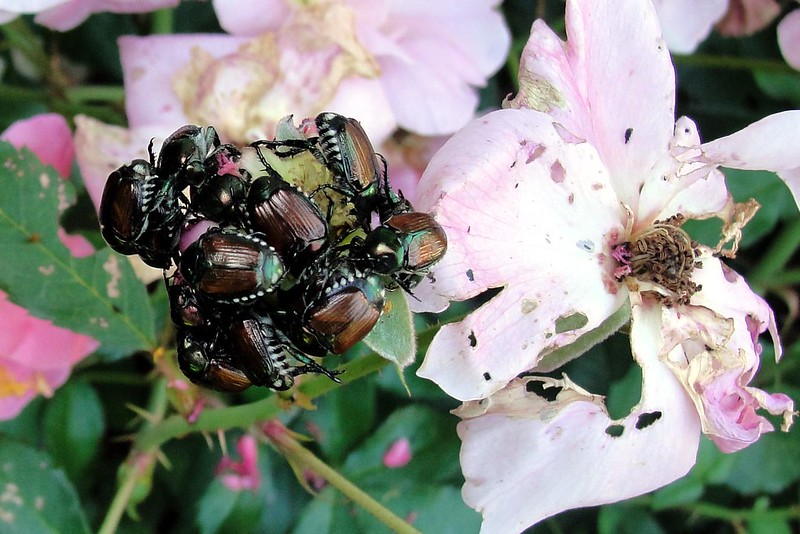
Japanese beetles (Popillia japonica) take a liking to over 300 different ornamental and agricultural plant species. They’re primarily active as adults between the times of June 1st until September 30th. When the pest isn’t enjoying their flight season, they are underground in the larval stage for a 10 month period.
The habitat conditions that are considered favorable for these pests for them to optimally grow is in wet/moist soil conditions. These conditions prevent the larvae from drying out. The moist soil also keeps many of the plants that the grubs prefer thriving through the changing seasons so that they may feed on the roots of the plants.
During their flight period, the beetles can fly within a 5-mile radius allowing them to mate and reproduce in different environments that suit their needs. While 5 miles may not seem like a lot, it is still enough distance for them to find new plants to destroy and new soils to infiltrate.
Somebody Stop ‘Em!
Understanding how the Japanese beetle works is an important part of defining the solutions to the pest. Whether it’s their expansive plant palate or their underground developmental phases, one thing is for certain, if left unchecked, the Japanese beetle could change the availability of the plants in the United States.
This spring the Iowa State University Extension and Outreach Field Agronomists reported a higher count of grubs throughout the state of Iowa. [1] But, they weren’t the only ones! States that are commonly affected by this pest, such as, Nebraska, Missouri, Kansas, Minnesota, North Dakota, South Dakota, Arkansas, and Oklahoma also noticed an increase in the number of Japanese beetles throughout their states.
Despite growers best efforts, the Japanese beetle continues to present challenges in successful eradication from the United States. How is it that despite the best Integrated Pest Management plans, these beetles continue to rear their ugly heads year after year?
Determining the amount of a pest from year to year can be challenging for plant owners and growers alike. But, the answer may be slightly easier than expected.

Resolving the Problem
Like any organism on our planet, the Japanese beetle’s population is affected by the environmental and biological conditions of its habitats. This means that everything from how much rain falls within the seasons, to how many predators are present will affect the size of the Japanese beetle population.
Taking note of these factors and accounting them into our solutions will ultimately provide the most effective and expansive practices to remove the pests. Scientists and growers have already lifted a tremendous amount of the leg work to identify solutions in combating the growing beetle population.
In considering the environmental controls that can be implemented in order to fight the Japanese beetle there are a few different options to be considered.
The first is evaluating the environmental factors that are most reasonably out of your control, such as, how dry the soil naturally is. Since Japanese beetles prefer wet/moist soil conditions it would be unreasonable to think you could control the amount of rain that falls and affects your soil moisture.
However, it wouldn’t be unreasonable to evaluate how much water you use within seasons that grubs underground may benefit from. How much water that is retained in your soil will impact the grub/larvae habitat.
In addition, taking early note of dead patches of grass may indicate the presence of grubs in your soil and is recommended to treat the soil directly, but not always effective to treat for the grubs. With whatever grass treatment method you use, be sure to check with how this may affect your underground water supply.
The next solution to preventing an abundant Japanese beetle season is still within environmental controls. This time, however, the solution focuses on the types of plants that are grown, and their resistance to the beetle. If at all possible, consider rotating crops and planting plants that aren’t favored by the beetle, or are naturally resistant to it.
USDA APHIS recommends these top 20 Woody Plants as Japanese beetle resistant options [3]:
1. Red maple Acer rubrum
2. Boxwood Buxus spp.
3. Hickory Carya spp.
4. Redbud Cercis spp.
5. Tulip poplar Liriodendron tulipifera
6. Dogwood Cornus spp.
7. Burning-bush Euonymus spp.
8. Forsythia Forsythia spp.
9. Ash Fraxinus spp.
10. Holly Ilex spp.
11. Juniper Juniperus spp.
12. Sweetgum Liquidambar styraciflua
13. Magnolia Magnolia spp.
14. Spruce Picea spp.
15. Pine Pinus spp.
16. Northern red oak Quercus rubrum
17. Lilac Syringa spp.
18. Yew Taxus spp.
19. Arborvitae Thuja spp.
20. Hemlock Tsuga spp.
They also recommend these 20 Herbaceous Plants as resistant against the Japanese Beetle [3]:
1. Ageratum Ageratum spp.
2. Columbine Aquilegia spp.
3. Dusty-miller Centaurea cineraria, Lychnis coronaria
4. Begonia Begonia spp.
5. Lily-of-the-valley Convallaria majalis
6. Coreopsis Coreopsis spp.
7. Larkspur Delphinium spp.
8. Foxglove Digitalis spp.
9. California poppy Eschscholzia californica
10. Coral-bells Heuchera sanguinea
11. Hosta Hosta spp.
12. Impatiens Impatiens spp.
13. Lantana Lantana camara
14. Forget-me-not Myosotis spp.
15. Pachysandra Pachysandra spp.
16. Poppy Papaver spp.
17. Moss-rose Portulaca grandiflora
18. Showy sedum Sedum spectabile
19. Nasturtium Tropaeolum majus
20. Violet, pansy Viola spp.
By considering one of the selections above, your environment is automatically designed to have some degree of resistance against the pest and provide better habitation for other species.
The next factor to consider in battling a Japanese beetle infestation is predatory methods. Part of the success of the Japanese beetle in the United States is that its initial presence didn’t have a predatory species. Due to the natural biological lag in evolution and predation, species identification that would be combative against the pest has taken some time and serious amounts of patience.
In the current day and age of science, predatory approaches to control the pest have been identified favored in hopes to eliminate the use of chemical pesticides, as well as hoping for increased effectiveness.
There are two types of predators of the beetle that are most commonly used for pest management. The first is the tachinid fly[2]. This insect can be attracted by growing plants that the insect favors, or by directly introducing the species into your environment. The pest targets adult beetles, spiders, larvae, grasshoppers, earwigs, caterpillars, sawfly larvae, true bugs, and Japanese beetles.
The second predatory organism to consider is two types of insect-eating nematodes. The two nematodes that have been noted by the USDA APHIS team as most effective against the Japanese beetle are Steinernema glaseri and Heterorhabditis bacteriophora. The nematodes are roundworm parasites that eat the Japanese beetle grubs, removing them from your soil.
The challenge with using nematodes is that depending on where you send your plants as a grower, there are different restrictions against nematodes in plants.
Whether through the predatory methodology or through environmental efforts against the insects, there are a number of ways to combat the Japanese beetle. Through the continued efforts of growers and scientists, control and eradication of the pests ARE possible.

Taking the Steps to Eliminate the Problem
Part of the struggle of the Japanese beetle is being able to predict the considerable amount of variables that have made the pest such a success within their environments. The challenge that we face as growers and plant owners is to remain consistent and innovative in our efforts against the species.
While change doesn’t occur overnight, and evolution can take time to naturally combat this invasive species, it is our responsibility to take as many necessary avenues as possible to control and eliminate the species from our lands.
Our efforts cannot be limited to only chemical resolve, but also in biological resolutions. The impact that this pest has against our food and our habitats, is the compassionate consideration we need to make in our treatment efforts. The direct relationship from the environment that we create and the number of Japanese beetles we see are undeniable. But, it is not always an option to simply plant something else. Through our efforts we can reclaim our plants for us, and remove the Japanese beetle from the equation.
To learn more about threats to the industry and first notifications of our latest blogs, be sure to signup for our e-mails!
Citations:
[1] Author: Erin Hodgson Professor Dr. Erin Hodgson started working in the Department of Entomology at Iowa State University in 2009. She is an associate professor with. (n.d.). Watch for Japanese Beetle Emergence. Retrieved August 17, 2020, from https://crops.extension.iastate.edu/cropnews/2020/06/watch-japanese-beetle-emergence
[2] Japanese Beetles and Natural Enemies. (n.d.). Retrieved August 17, 2020, from https://extension.umd.edu/ipm/japanese-beetles-and-natural-enemies
[3]Japanese Beetle. (n.d.). Retrieved August 17, 2020, from https://www.aphis.usda.gov/aphis/ourfocus/planthealth/plant-pest-and-disease-programs/pests-and-diseases/japanese-beetle/japanese-beetle


